What Connects Ice Fishing to Other Game Shows
Understanding the foundational elements shared across the game show category makes it easier to evaluate individual titles against one another. Every Evolution game show is built on the same structural pillars, and recognising these shared traits helps Canadian players see both the common ground and the meaningful differences between options.
The first pillar is the live host. A professional presenter works from a purpose-built studio, guiding each round with real-time commentary, authentic reactions, and a broadcast-style energy that transforms the experience from a solitary gambling exercise into a shared entertainment event. The host is not decorative — they are central to the emotional texture of every session, and Evolution invests heavily in training to ensure a consistent standard across all titles and studio locations.
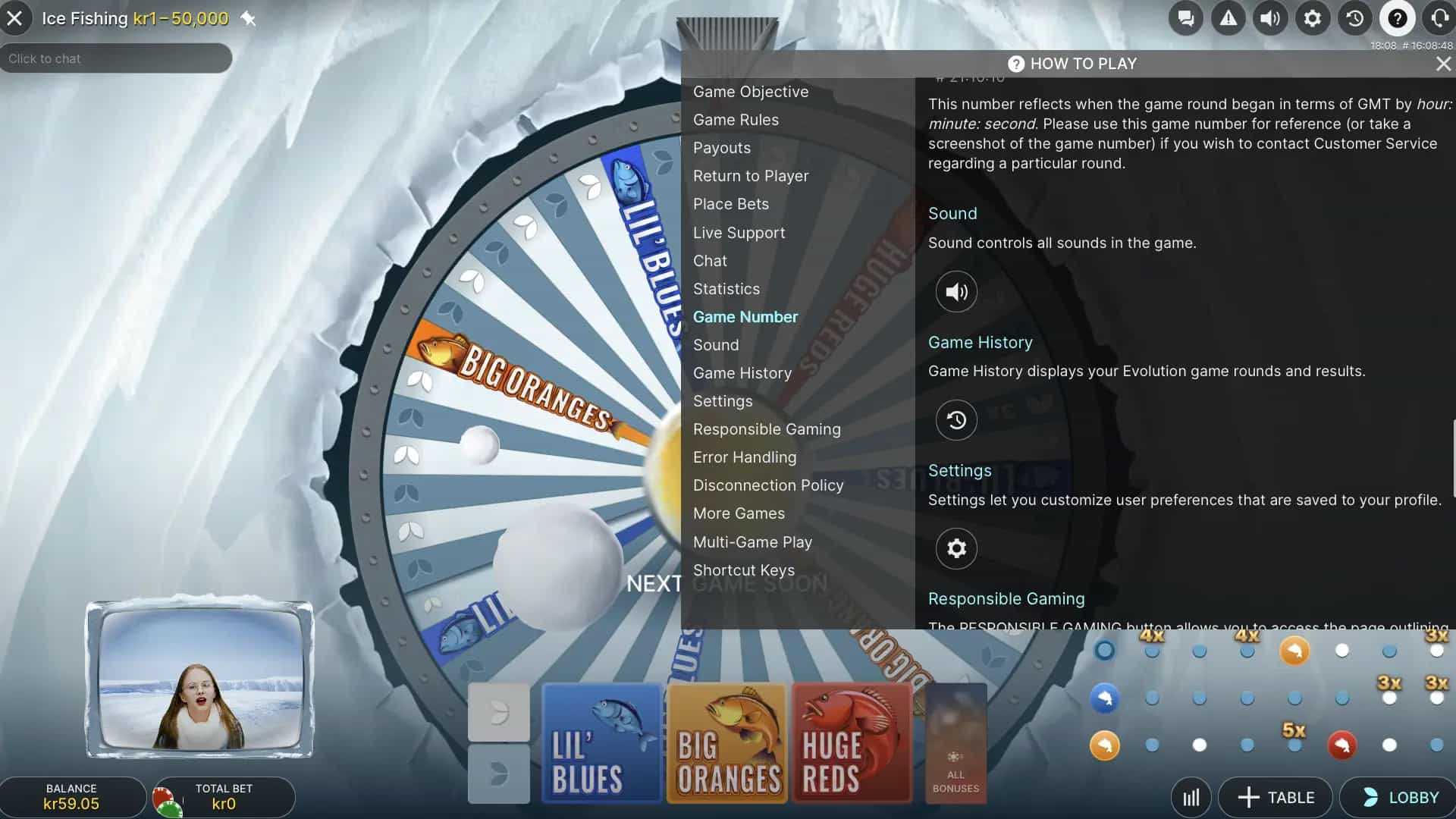
The second pillar is the spinning wheel. Whether it contains 53 segments like Ice Fishing or a different count, the wheel serves as a universally understood focal point that requires zero explanation. Players see the segments, track the rotation, and feel the tension as the flapper decelerates — an experience so intuitive that it transcends language barriers and experience levels. This accessibility is deliberate: it keeps game shows welcoming to newcomers while the bonus systems layered on top provide depth for experienced players.
The third pillar is the bonus round system. Landing on a designated wheel segment transports you out of the main game and into a secondary environment where enhanced multipliers and elevated payouts are available. The specifics vary wildly — from Ice Fishing's Arctic catch reveal to Crazy Time's four distinct mini-games — but the structural concept is consistent. Bonus rounds create tentpole moments that give each session a narrative shape, punctuating the rhythmic base game with dramatic peaks.
For Canadian players, the practical benefit of these shared foundations is portability. Once you are comfortable with one Evolution game show, moving to another requires minimal adjustment. The interfaces share common conventions, the betting mechanics follow similar patterns, and the live host format feels immediately familiar regardless of the specific title. This makes exploring the full catalogue a low-friction activity that expands your entertainment options without demanding significant new learning.
Side-by-Side Comparison of Major Titles
Data-driven comparison is often more efficient than descriptive discussion. The table below places Ice Fishing alongside its closest competitors across the metrics most relevant to player decision-making: bonus quantity, maximum return, and core gameplay mechanic.
| Title | Developer | Bonus Count | Peak Payout | Central Mechanic |
|---|
| Ice Fishing | Evolution | 3 | 5,000x | Wheel + three-tier Arctic fishing reveal |
| Crazy Time | Evolution | 4 | 20,000x | Wheel + four varied mini-games |
| Dream Catcher | Evolution | 0 | 7x wheel multiplier | Wheel only, no separate bonus rounds |
| Monopoly Live | Evolution | 1 | Variable (3D board) | Wheel + augmented reality Monopoly board |
| Funky Time | Evolution | 4 | Variable (disco rounds) | Wheel + four dance-themed bonus games |
| Sweet Bonanza CandyLand | Pragmatic Play | 3 | Variable | Wheel + candy-themed bonus rounds |
Several patterns emerge from this comparison. Dream Catcher sits alone at the minimal end of the complexity spectrum with zero dedicated bonus games. Crazy Time and Funky Time share the maximum bonus count at four each, though their bonus mechanics differ substantially in tone and execution. Ice Fishing occupies a balanced middle position with three tiers — enough variety to prevent monotony, few enough to remain immediately comprehensible. The 5,000x maximum return is competitive without reaching the extreme heights (and corresponding extreme volatility) of Crazy Time's 20,000x ceiling. Sweet Bonanza CandyLand from Pragmatic Play demonstrates that Evolution does not have a complete monopoly on the format, though Evolution's titles collectively dominate the category in terms of both player numbers and critical reception.
Crazy Time — The Category Leader
If any single title defines the Evolution game show format in the public consciousness, Crazy Time holds that position. Launched in 2020, it rapidly became the most-streamed and most-played live game show in the world — a status it has maintained through a combination of sheer multiplier potential, bonus variety, and viral social media presence. The game features four completely distinct bonus rounds: Cash Hunt (an interactive target-shooting gallery), Pachinko (a physical puck-drop mechanism), Coin Flip (a binary multiplied outcome), and the eponymous Crazy Time round (a secondary wheel in a carnival environment).
The defining characteristic of Crazy Time relative to Ice Fishing is its ceiling. A maximum payout of 20,000x — four times higher than Ice Fishing's cap — creates moments of extraordinary potential that generate enormous excitement among players and viewers alike. The trade-off is volatility: big hits in Crazy Time are rarer and the stretches between them longer, demanding greater patience and a larger bankroll buffer. Canadian players comfortable with extended dry spells in exchange for occasional explosive results will find Crazy Time exhilarating. Those who prefer more frequent, moderate-sized wins may find Ice Fishing's tighter multiplier ranges more satisfying on a session-by-session basis.
The four-bonus structure also means Crazy Time offers more mechanical variety within a single session. Each bonus plays entirely differently from the others, preventing any repetitive feeling even across multi-hour sessions. However, the diversity that makes Crazy Time engaging for experienced players can feel overwhelming for newcomers who are still learning what each bonus entails and how to respond to it. Ice Fishing's simpler three-tier system is easier to internalise quickly, making it a more accessible starting point for players who want bonus variety without information overload.
It is also worth noting that Crazy Time's popularity has made it one of the most-streamed casino games on platforms like Twitch and YouTube, which means Canadian players considering the title can watch extensive footage of real sessions before committing their own funds. This transparency is a unique advantage that newer titles like Ice Fishing have not yet fully developed in terms of publicly available viewing material.
Dream Catcher — The Original Format
Every Evolution game show traces its lineage back to Dream Catcher, released in 2017 as the company's first dedicated game show title. It proved the concept that players would enthusiastically engage with a wheel-based live format hosted by a professional presenter — a hypothesis that was far from guaranteed at the time. Without Dream Catcher's commercial success, titles like Ice Fishing would likely never have been developed.
Dream Catcher's design is deliberately minimalist. There are no separate bonus rounds, no secondary environments, and no catch reveals. The wheel itself contains multiplier segments — 2x and 7x — that amplify the next winning spin when they appear. The entire experience takes place on the main wheel, and the rules can be understood in under thirty seconds. This radical simplicity is both the game's greatest strength and its clearest limitation.
For Canadian players who have never tried a live game show, Dream Catcher remains arguably the best starting point. Its gentle learning curve and uncomplicated mechanics remove all barriers to entry. However, players who have experienced the three-tier bonus system of Ice Fishing or the four-bonus depth of Crazy Time may find Dream Catcher's single-wheel format too understated for their tastes. It functions most effectively as a gateway — the place where you develop comfort with the game show format before moving on to richer, more feature-complete titles.
Despite its simplicity, Dream Catcher maintains a loyal player base among Canadian players who specifically value straightforward, low-complexity entertainment. Not everyone wants multi-stage bonus rounds or elaborate thematic environments. For players who find those elements distracting rather than enhancing, Dream Catcher's clean, unadorned format is a deliberate feature rather than a limitation. Understanding this preference split is important when choosing between Dream Catcher and more complex alternatives like Ice Fishing — neither is inherently better, they simply serve different appetites.
Monopoly Live — A Familiar Brand Reimagined
Monopoly Live takes a different approach to differentiation by anchoring its appeal in one of the world's most recognisable board game brands. The main wheel operates on familiar principles, but the standout feature is the bonus round: an augmented reality Monopoly board that appears to materialise physically in the studio space. When triggered, a top-hatted character rolls dice, moves around the board, and collects multipliers from properties — with houses and hotels increasing the values. The entire sequence plays out in real time, narrated by the live host.
The brand recognition factor gives Monopoly Live a unique advantage in attracting players who might not otherwise explore the game show category. The Monopoly name carries decades of cultural weight, and the bonus round taps into the same property-accumulation excitement that has kept the board game popular across generations. For Canadian players specifically, Monopoly's deep cultural penetration in North America means the game carries an instant familiarity that no original IP can replicate.
Compared to Ice Fishing, Monopoly Live offers a single but substantially more complex bonus round rather than three simpler tiers. Where Ice Fishing's bonuses resolve through a progressive fish reveal, Monopoly Live's bonus unfolds as a multi-step board traversal with variable outcomes at each property. Players who prefer depth and narrative complexity in a single bonus experience may find Monopoly Live more compelling, while those who value the variety that comes from three distinct tier levels may lean back toward Ice Fishing.
Funky Time — Pure Entertainment Energy
Funky Time is Evolution's most overtly entertainment-driven game show, wrapping the wheel-and-bonus format in a disco-themed production that prioritises energy, spectacle, and fun above all else. Four bonus rounds are available, each set in a vibrant, musically charged environment. The live hosts tend to be more performative than in other game shows, actively dancing and engaging with the theme in ways that make sessions feel like parties rather than structured gambling events.
The game appeals most strongly to players who view game shows primarily as entertainment — with winning potential as a welcome secondary benefit rather than the sole motivation. Funky Time's four-bonus structure places it alongside Crazy Time in terms of raw variety, though its bonus mechanics lean more toward visual and auditory spectacle than Crazy Time's more diverse strategic approaches. Compared to Ice Fishing's cohesive Arctic narrative, Funky Time trades thematic depth for relentless disco energy — an aesthetic preference that divides players cleanly according to personal taste.
Canadian players who find traditional casino aesthetics too serious or formal often discover that Funky Time's irreverent tone is exactly what they were looking for. The game actively breaks the mould with its colour palette, soundtrack, and host behaviour, creating an atmosphere that feels distinctly modern and casual. If Ice Fishing appeals through immersive themed storytelling, Funky Time appeals through its refusal to take itself seriously — and for the right audience, that levity is the entire point. The contrast between the two titles also illustrates the remarkable breadth of Evolution's creative range within a single product category.
Finding the Right Game for Your Priorities
With several strong options sharing structural similarities, the choice of which game show to play often comes down to personal preference rather than objective superiority. The following table maps common player priorities to the title that most directly addresses each one, providing a practical decision-making framework for Canadian players.
| Your Priority | Recommended Title | Rationale |
|---|
| Maximum possible payouts | Crazy Time | 20,000x ceiling is unmatched across the entire category |
| Simple, no-frills experience | Dream Catcher | Wheel-only format with zero bonus complexity to learn |
| Distinctive theme with tiered bonuses | Ice Fishing | Arctic setting, three escalating bonus levels, progressive reveal |
| Brand familiarity and nostalgia | Monopoly Live | Licensed Monopoly IP with immersive 3D board game bonus |
This framework is a starting point, not a final destination. Most experienced Canadian players maintain a rotation of two to four game shows that they cycle through based on mood, available time, and appetite for risk. The shared interface conventions across Evolution's lineup make switching between titles effortless, so there is no practical cost to maintaining variety in your playing habits.
Universal Traits of Premium Game Shows
Regardless of which specific title you choose, the highest-quality game shows share certain characteristics that distinguish them from lesser offerings. Recognising these traits helps Canadian players quickly assess new releases and avoid spending time on titles that lack the substance to deliver a genuinely engaging experience.
- Trained live hosts in purpose-built studios — Professional presenters working in broadcast-quality environments are the foundation of any premium game show. The host drives the energy and personality of each session, and the studio's production values directly impact visual immersion.
- Wheel-based central mechanic — The spinning wheel provides a universally intuitive focal point. Its visual transparency — you can see every segment, track the rotation, and follow the flapper — creates natural suspense without requiring any rule knowledge.
- Bonus rounds with amplified rewards — Dedicated bonus environments with higher multiplier ceilings than the base game create narrative peaks that give sessions dramatic structure. Without these tentpole moments, extended play can feel monotonous.
- Full mobile compatibility — Top-tier game shows run identically on desktop and mobile, with touch-optimised interfaces and bandwidth-efficient streaming. Device choice should never compromise the experience.
- Professional audiovisual production — Crisp video, clear audio, smooth animations, and responsive AR overlays transform each session into a polished broadcast rather than a low-budget stream. Production quality is one of the strongest indicators of a game show's overall calibre.
Building a Personal Game Show Rotation
Rather than committing to a single title, experienced Canadian players often build a curated rotation of game shows that they cycle through depending on circumstances. A well-designed rotation provides variety that prevents any single game from becoming stale, while the shared Evolution interface conventions ensure that switching between titles feels seamless and cost-free.
A practical rotation might position Ice Fishing as the everyday default — fast-paced, moderately volatile, with a satisfying three-tier bonus system that delivers consistent engagement. Crazy Time could serve as the high-ceiling option reserved for sessions when you want maximum potential upside and are prepared to accept the corresponding volatility. Dream Catcher fills the role of a low-intensity wind-down game for brief sessions or relaxed play. Monopoly Live or Funky Time provides thematic variety when the Arctic setting of Ice Fishing or the carnival atmosphere of Crazy Time needs a change of scenery.
Demo modes across all these titles make constructing your rotation risk-free. A single afternoon spent sampling Dream Catcher, Monopoly Live, and Funky Time in free play — perhaps thirty minutes on each — provides enough exposure to determine which titles resonate with your personal preferences. This exploration phase costs nothing and delivers lasting value, ensuring that when you play for real money, you are always engaging with a title that genuinely appeals to you rather than defaulting to whatever loads first in the casino lobby.
Your rotation will also naturally evolve over time as you accumulate more experience and as Evolution releases new titles. A game that feels fresh and exciting today may become routine after fifty sessions, at which point swapping it for a different option refreshes the experience. The key principle is flexibility: treat your rotation as a living arrangement that adapts to your evolving tastes rather than a fixed commitment. Ice Fishing might be your primary title this month, but three months from now a newly released Evolution game show could take its place while Ice Fishing shifts to a secondary position. The category is designed for this kind of organic exploration.
Start with the pace of the main game
Evolution presents Ice Fishing as a live speed game show, so pace is an important starting point when comparing it with another format. A faster structure may suit players who want the main action to move quickly, while a more drawn-out presentation may appeal to those who prefer extra build-up between outcomes.
Look beyond the visual theme and consider how much attention each round demands. Ask whether the format makes its choices clear, whether the sequence is easy to follow and whether bonus features interrupt or complement the main action. These practical details can tell you more than surface similarities.
Compare how the wheel shapes each round
The main Ice Fishing game uses a virtual wheel with 53 segments. That gives you a concrete reference point when assessing another wheel-led game-show format. Instead of assuming that every wheel game works in the same way, compare the number and arrangement of the available outcomes, the role of special segments and the amount of information shown before the wheel resolves.
A wheel can be the central decision point or simply one part of a broader sequence. Decide which style you prefer: a format that keeps attention firmly on one main wheel, or one that shifts more often between the base game and separate features.
Use multipliers as a comparison point
The official Ice Fishing page says random multipliers of up to 10x may be applied to wheel segments. When considering a different format, check how its multiplier mechanic fits into the round rather than focusing only on the largest displayed figure. A useful comparison considers when a multiplier can appear, what it applies to and whether its role is understandable during play.
Examine the bonus structure
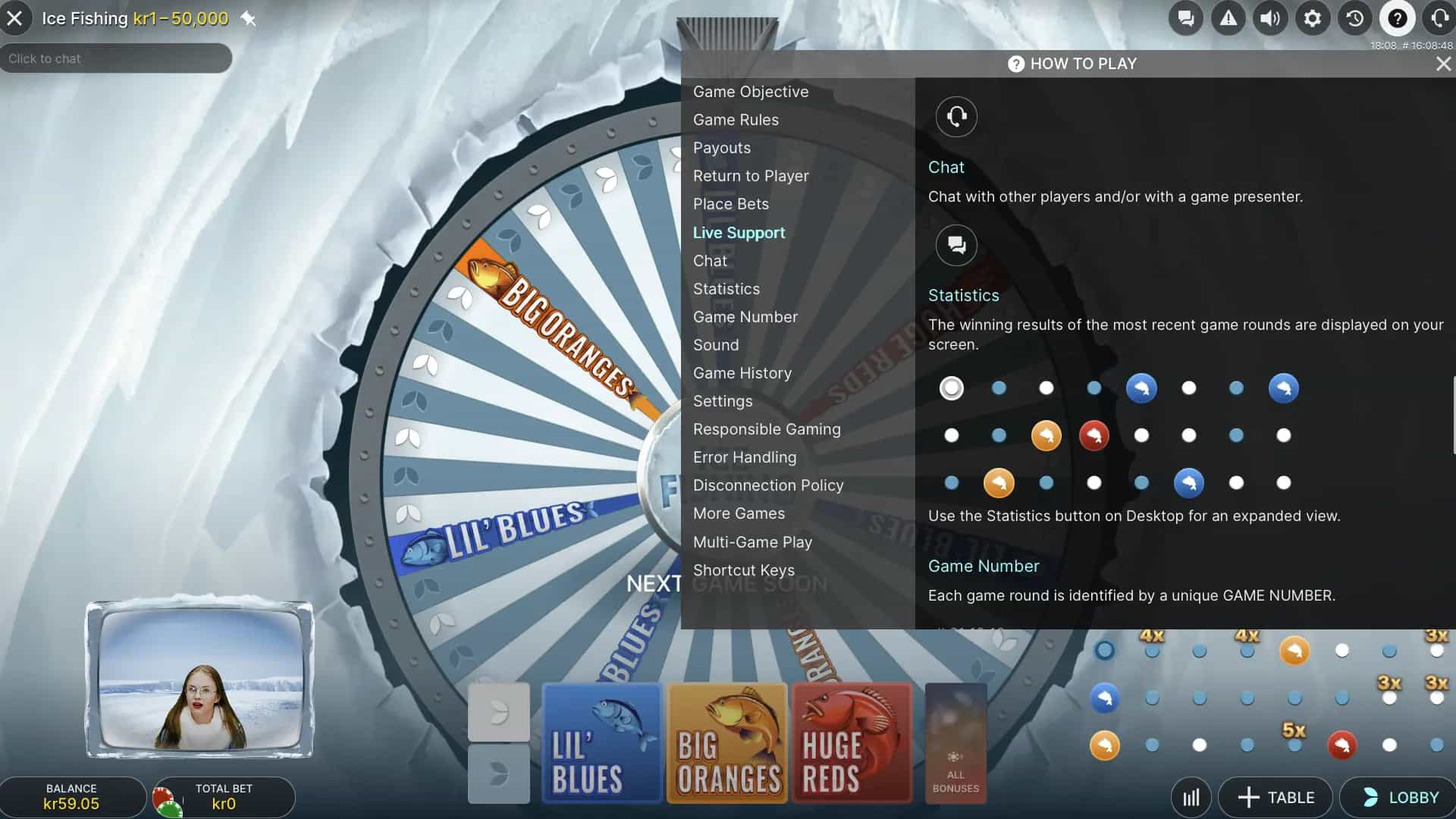
Ice Fishing has three Bonus game options: Lil' Blues, Big Oranges and Huge Reds. This three-option structure provides a clear benchmark for comparing bonus variety. Some readers may prefer several distinct choices, while others may favour a simpler format with fewer transitions.
Consider whether the bonus options feel meaningfully different from one another. Compare their presentation, the number of decisions involved and how quickly each feature reaches its result. The strongest match for your preferences is not necessarily the format with the most features; it is the one whose features are easiest for you to understand and enjoy.
Choose by structure, not by name
When looking for games like Evolution Ice Fishing, use a short checklist: pace, wheel design, bonus structure and clarity. Begin with the feature that matters most to you, then compare the remaining elements in order. This approach avoids choosing solely because another game has a similar theme or presentation.
- For quicker sessions: prioritise a clearly explained, fast-moving main game.
- For wheel-focused action: examine how outcomes and special segments are arranged.
- For bonus variety: compare the number and style of separate features.
- For simpler play: favour a format whose round sequence is easy to track.
Ice Fishing combines a live speed format, a 53-segment virtual wheel, three named Bonus game options and random multipliers that may reach 10x. Use those verified characteristics as your baseline, then judge other game-show formats feature by feature.
Questions and answers
How many segments are on the Ice Fishing wheel?
The main game uses a virtual wheel with 53 segments.
What Bonus game options does Ice Fishing have?
The three Bonus game options are Lil' Blues, Big Oranges and Huge Reds.
Can multipliers appear on Ice Fishing wheel segments?
Yes. The official page says random multipliers of up to 10x may be applied to wheel segments.
Explore Ice Fishing
Last reviewed: 02 September 2026, 21:12 UTC.